
How to Check Criminal History in New London
Choose the New London record by purpose. A police report describes the city agency’s event and investigative work. A Judicial docket shows charges filed in Superior Court and their outcome. CT DOC reports state custody. SPBI supplies identity-linked Connecticut history for personal review.
- Confirm that New London Police, rather than State Police or a federal agency, created the event record.
- Submit the incident, accident, or local-check request through the city’s required GovQA route.
- Search Connecticut Judicial criminal dockets in pending and conviction views, then note the displayed court.
- Use CT DOC for current state custody, not as proof that a conviction occurred.
- Follow CCHRS and SPBI instructions when a personal statewide, identity-linked record is needed.
Use dates, location, police case number, docket number, and charge descriptions to compare results. A New London arrest charge can change before filing. Restricted or erased matters may not appear in ordinary public searches.
New London Police Made GovQA Mandatory
Effective January 1, 2024, the New London Police Records Section directs all requests through GovQA. That includes incident reports, accident reports, and advertised local background checks. The live New London Police Records page controls the current workflow.
GovQA creates a trackable request and sends electronic notices. The city’s older NLPD-0069 PDF remains useful only as a clue to the information staff needs. It should not be treated as the current filing route. A request submitted through an obsolete form can miss the mandatory portal process.
Current route: Use the GovQA link from the live Police Records page. Give the incident date or range, location, case number if known, exact record category, and a clear description of every requested item.
Attachments may support identification or clarify scope when the portal allows them. Do not upload material that is not needed for the request.
The New London Police Department
The New London Police Records Section is at 5 Governor Winthrop Boulevard. The police main number is 860-447-5269. Posted records-window hours are 8:45 a.m. to 3:45 p.m. on weekdays, with a possible closure from 12:30 to 1:15 p.m. Confirm the window before travel.
New London Police Records Section
5 Governor Winthrop Boulevard
New London, Connecticut
860-447-5269
GovQA is required for incident, accident, and local-check requests.
The city office holds records created by New London officers. It may review incident and arrest reports, calls or CAD material, audio, photographs, and video, but requesters should name each medium. The Superior Court clerk does not hold the police narrative. Conversely, Police Records is not the custodian of filed motions, pleas, or court judgments.
Build a Precise New London GovQA Request
A precise portal description reduces the time spent identifying the event. Start with the police case number. If it is unknown, use date, approximate time, location, parties, and a short event description. State whether the request seeks a report, arrest supplement, accident file, CAD record, 911 audio, photographs, or video.
| GovQA control | How it helps |
|---|---|
| Account email and password | Supports portal notices, tracking, and responses |
| Requester details | Provides the delivery and contact context |
| Request description | Names the incident and exact material sought |
| Date range or incident date | Narrows the New London search |
| Location and case number | Supplies the strongest event identifiers when known |
| Category selector | Routes police incident, accident, or local-check requests |
| Attachments | Adds authorization, identification, or clarification only when applicable |
Ask for electronic delivery or inspection and an estimate before paper copies. Audio and video can require more redaction work than a basic report.
Arrests and Bookings in New London
New London Police creates its own arrest and local booking records. Those files may include event and arrest dates, location, officer or unit, initial charges, warrant basis, fingerprints, booking photo, bond, transport, and court date. Protected identifiers, victim data, medical facts, and investigative material may be removed from public copies.
A person committed to detention moves into the state-run Connecticut Department of Correction. There is no New London city jail search or county sheriff booking log. Search the CT DOC locator by inmate number when possible, or use name plus other identifying data. It includes accused pretrial people and sentenced inmates, so incarceration is not proof of guilt.
A recent police arrest may not yet have a public docket. Request the local record, allow filing time, and search Judicial pending cases. The New London County arrest history page explains the full arrest-to-custody route.
Four-Day Response Is Not Delivery
Connecticut’s four-business-day FOIA framework concerns acknowledgment or response, not a promise that every New London criminal record will be produced within four days. The office may need to locate files, consult legal staff, review exemptions, redact protected details, calculate costs, or clarify an overbroad request.
Keep the GovQA confirmation and watch messages from the portal. Answer a reasonable clarification with a tighter date range or record description. If the city denies access, ask it to identify the legal basis. Qualifying municipal denials may be appealed to the Connecticut Freedom of Information Commission under §1-206, generally within 30 days.
An active case can illustrate the product split. The public court docket may confirm charges while Police Records is still reviewing the incident narrative for release. Neither channel is necessarily wrong; each has a different custodian and disclosure rule.
New London Municipal Court Records
New London has no municipal criminal court. The Connecticut Superior Court system handles city criminal cases. G.A. 10 at 112 Broad Street is the local Part B court. Serious Part A matters are centered at 70 Huntington Street. Both buildings are within New London, but each keeps its own assigned files.
| Court Name | Connecticut Superior Court G.A. 10 and New London Judicial District Part A |
|---|---|
| Case Types Heard | Part B criminal, infraction, and motor-vehicle matters at Broad Street; serious Part A matters at Huntington Street |
| Case Lookup Channel | Judicial Criminal/Motor Vehicle defendant or docket-number search, then the displayed clerk |
| What the Docket Shows | Docket number, court, charges, dates, status, events, plea, disposition, sentence, bond, and counsel when public |
| Copies & Fees | Ask the assigned criminal clerk about electronic inspection, copies, certification, and current fees |
Call G.A. 10 at 860-443-8343. For Part A, the Chief Clerk’s Office is 860-443-5363 and the Criminal Clerk is 860-447-0893. Use the docket location rather than assuming the nearest building holds the file.
Broad Street Versus Huntington Street
The two New London courthouses are close, but their records do not merge. G.A. 10 principally handles class C, D, and E felonies, misdemeanors, infractions, and motor-vehicle matters for assigned towns. Part A principally handles class A and B felony matters across the Judicial District. Case-specific transfers can change that broad split.
The G.A. 10 court page identifies 112 Broad Street, on-street parking, SEAT bus service, and front-door wheelchair entry. Doors open at 8:30 a.m., while office hours are 9:00 a.m. to 5:00 p.m. Confirm current security and electronics rules before a visit.
The public docket is the best routing signal. Record its number and court, then contact that clerk. The police case number alone may not direct a clerk to the filed matter.
New London Justice Offices Differ
The New London State’s Attorney and Judicial District Public Defender are based at the Part A courthouse. The State’s Attorney’s office prosecutes serious district cases; the public defender represents qualifying defendants. Neither office is a general criminal-record search service.
The official public defender directory documents the New London Judicial District office.
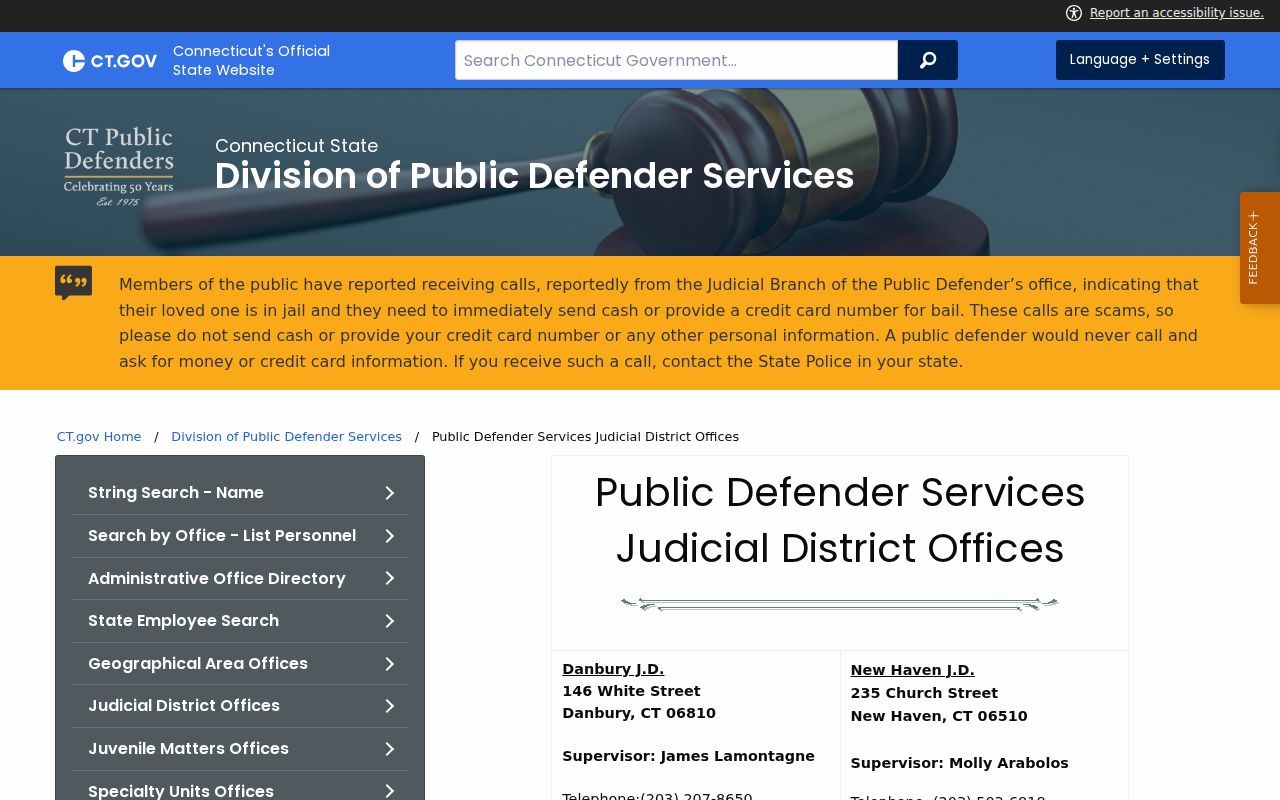
The image adds office context while reinforcing that court copies still come from the clerk.
The State’s Attorney headquarters is at 70 Huntington Street, with G.A. 10 prosecution at Broad Street. Victim advocates and defense counsel serve distinct roles. A person seeking a police report should stay with GovQA; a person seeking a public docket document should stay with the assigned clerk.
Where New London Records End Up
A city arrest begins with the New London Police report and local processing. Once prosecutors file charges, Superior Court creates the case docket. Fingerprint and disposition reporting can feed SPBI’s state criminal-history system. A custody commitment creates a separate DOC record.
Record flow: New London Police › Connecticut Superior Court G.A. 10 or Part A › Connecticut Department of Emergency Services and Public Protection, State Police Bureau of Identification
Use GovQA for the city narrative, Judicial lookup for filed charges and outcomes, DOC for custody, and SPBI for personal statewide history. These records can update at different times. Exact case and docket numbers make reconciliation far more reliable than a name alone.
Port Arrests May Have Other Custodians
New London’s port, Thames waterfront, Coast Guard Academy, rail corridor, I-95 access, and federal court presence make jurisdiction a practical records issue. An incident inside the city may still have been investigated by Connecticut State Police, Coast Guard Investigative Service, campus authorities, or another federal agency.
Before filing GovQA, identify the location and arresting unit. For a state police event, use DESPP’s GovQA route. For a federal prosecution, use PACER and confirm the hearing location with the U.S. District Court. The official federal court page identifies the New London location.
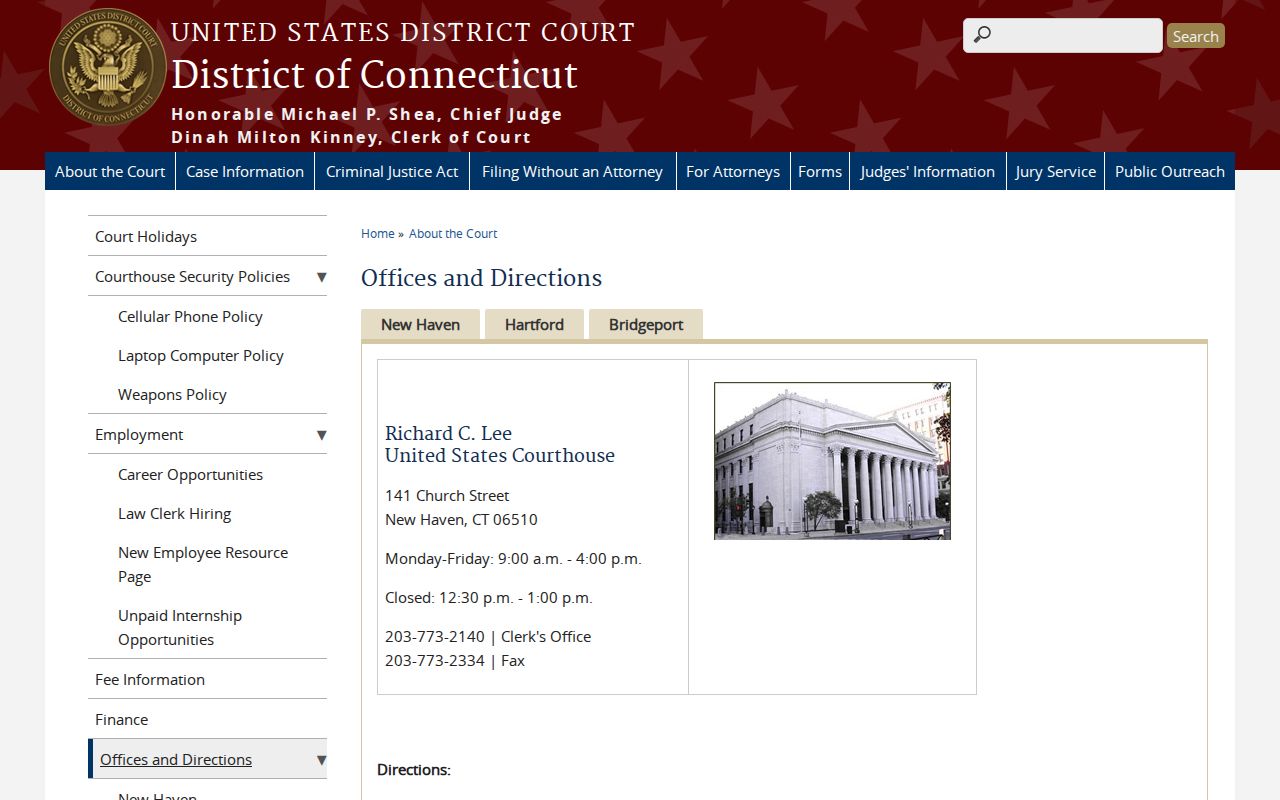
The federal source shows why a port-city record may sit outside the city and Connecticut court systems.
Correct New London Records Separately
Correcting a New London police report does not automatically rewrite the court docket or SPBI cycle. First identify the disputed field and the agency that supplied it. Send Norwich Police, the court clerk, DOC, or SPBI only the correction that belongs to that custodian. For a New London city report, use the GovQA thread and exact police case number.
Compare the police arrest date and initial charge with the docket’s filed charge and disposition. A difference can reflect normal prosecutor review rather than an error. If a case was erased or an absolute pardon granted, use the official order and identifiers when asking a government source to update its public record.
A public result disappearing is not proof that all downstream copies changed at once. Recheck the Judicial lookup and personal SPBI history after relief.
Public Access Rules for New London Records
Connecticut FOIA presumes access to public-agency records but preserves specific exemptions. New London Police can redact identifiers and protected victim information or withhold qualifying active investigative material. Court restrictions, juvenile and youthful-offender confidentiality, and erasure law can bar access even when a broad request is filed.
Key Statutes:
Connecticut FOIA §1-210 presumes public access unless state or federal law supplies an exemption.
Connecticut General Statutes §1-206 creates the FOI Commission appeal process and filing period.
Connecticut General Statutes §54-142a controls erasure and later disclosure of qualifying criminal records.
Public access does not establish identity or guilt. Verify New London criminal history with the office that created the record and compare exact identifiers before relying on it.